

A decorated cake is vulnerable in ways that you only remember when it is in the backseat of the car. The box could slide while making a turn, the frosting could melt from the warmth inside a car, and an uneven floor can tilt the cake before it gets there. The ride is a quick one, but it is the time of day where the cake travels.
Proper handling will minimize the dangers although it cannot eliminate them all. This blog explains how to get your cake ready for transportation, select an appropriate position in the vehicle, and keep it still among others.
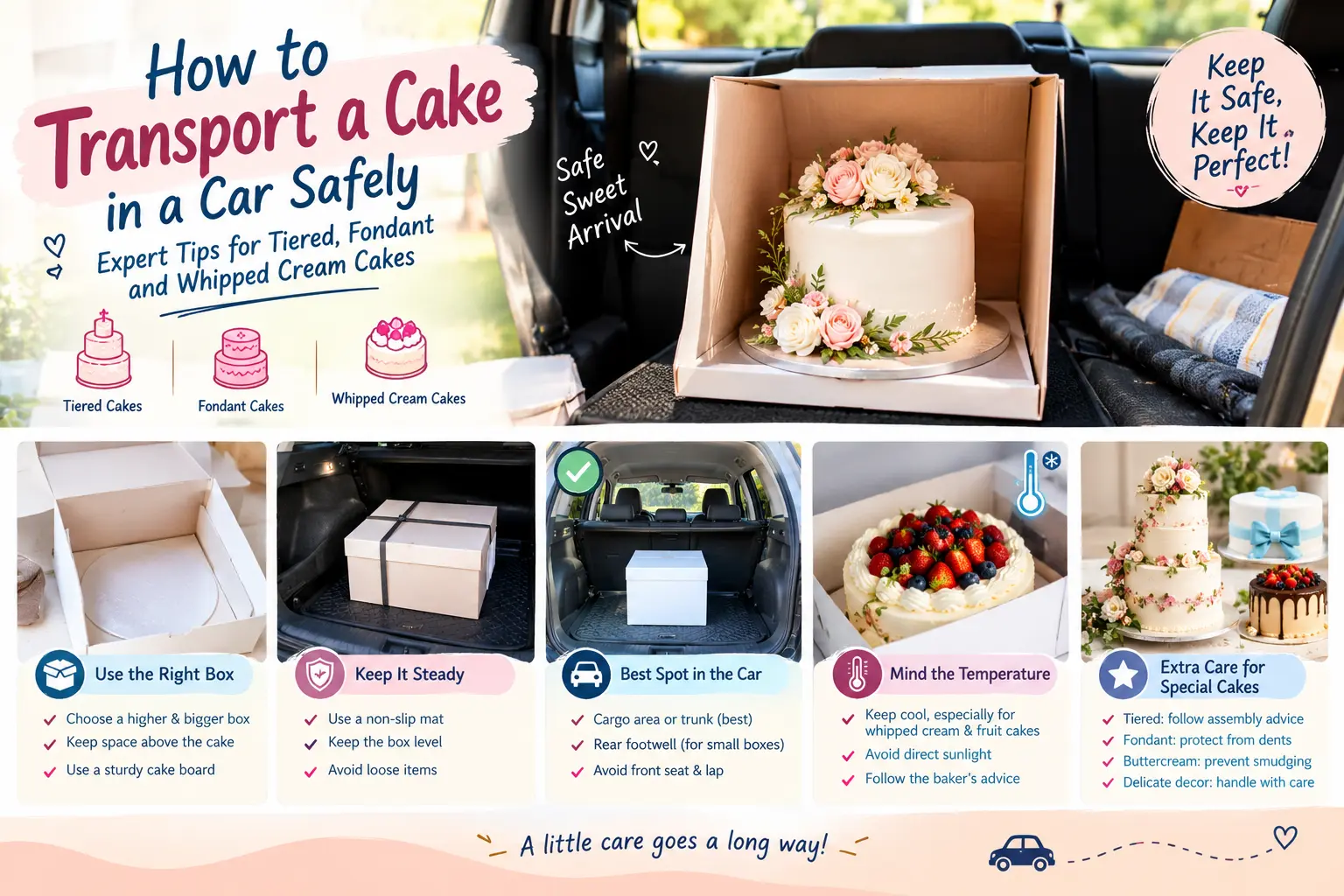
Quick answer: Follow the baker's handling instructions, keep the cake in a firm, snug box on a flat, non-slip surface such as the cargo floor or footwell, and drive slowly with early braking.
- A flat, secured floor is safer than a car seat, because seats slope and the box can tilt or slide.
- Never carry a cake on a lap or rely on a passenger's hand to hold the box in place.
- How a tiered cake should travel depends on how it was built, so ask the baker whether it goes in one piece or in sections.
Get the Cake and the Box Ready Before the Trip
A few checks before departure can reduce the risk of damage during the journey.
Follow the Baker's Handling Instructions
The right preparation all comes down to the type of filling used, the type of frosting and the type of decorating. While some cakes are best if taken directly from the refrigerator into the transport vehicle, other types of cakes are suitable to be left at a cool room temperature for the duration of a short trip. During the delivery process, it is advisable to find out the right temperature that the cake must maintain and how much time it can stay out of the fridge.
Health Canada's general food-safety guidance is to store food in a fridge at 4°C or below. In terms of cakes that have perishable filling, it is important to follow the baker’s refrigeration guidelines.
Pick a Box With Room
The lid and the sides must never touch the frosting or decorations; therefore, it is recommended to use a box that is higher and bigger than the cake. A solid board at the bottom of the cake, which is slightly bigger than the cake itself, provides you with something firm to grip onto while lifting the cake. It is advisable to measure the size of the box compared to the size of the cargo area.
Plan the Route and Timing
Plan the route to be taken in regards to the areas of roadworks, potholes, and high traffic density before going on the delivery run. In the case of the Toronto area, an area of slower traffic on the 401 or Gardiner would extend a short journey into a long one, and a smoother road would be preferred to a fast road when transporting the cake. The cake should be picked up last.
Choose a Spot in the Car That Is Flat, Cool and Secure
Choose a level, secure location for the box. The table below compares common options.
|
Spot in the car |
How well it works |
What to watch for |
|
Cargo area of an SUV or hatchback |
Often the best option |
The floor must be level and the box must fit, with the cake protected from other cargo and direct sun |
|
Trunk of a sedan |
Depends on the vehicle, weather and trip |
Trunks can hold heat on warm days, so limit the time the cake spends there |
|
Rear footwell |
Works for smaller boxes |
The box must sit flat and snug, with nothing resting on top |
|
Back seat |
Only if the box can be levelled and secured |
Seats slope backwards, so the box can tilt or slide |
|
Front seat or lap |
Avoid |
The surface is unstable and the cake is easily jolted |
Keep the Box Level and Still
A box that rests at an angle for the whole drive can leave a soft cake leaning on arrival. Aim for a flat, rigid surface, and if the floor is uneven, use a firm, flat support under the low side that cannot shift or compress. Before leaving, press gently on the box to confirm it sits flat and does not rock.
Stop the Box From Sliding
The use of a rubber shelf liner or a non-slip mat at the bottom of the box prevents sliding motion. Good support from the sides, in the form of adjacent boxes or packed towels that don’t move around, does not allow the cake any space to move. Spongy material may shrink when making a turn, therefore make sure to examine it before departure. What is needed is not a box under pressure but an immovable one, hence no seat belts.
Different Cakes Need Different Care in the Car
Buttercream softens differently from whipped cream, and a tall tiered cake carries different risks from a single layer.
|
Cake type |
Main risk |
What helps |
|
Buttercream |
Softening in heat, smudging |
Keep the car cool and the lid clear of the frosting |
|
Whipped cream or fresh fruit |
Softening and spoiling in warmth |
Keep cold, follow the baker's temperature guidance |
|
Fondant |
Dents and condensation |
Handle by the board, ask how long to leave it boxed on arrival |
|
Tiered |
Shifting layers, leaning |
Follow the baker's advice on assembled or separate transport |
|
Delicate decorations |
Cracking, falling off |
Ask which pieces travel on the cake and which travel separately |
Tiered Cakes
Since the tiered cakes have more height, the application of brakes might cause the whole cake to move. There are some tiered cakes which have supports from within that enable them to be transferred in their assembled form. There are other cakes which are designed for transportation in parts and assembly at the destination point.
The size and mode of transfer both matter.If tiers travel separately, give each its own box and keep every one level. Separate sections may be the better choice on a long drive or rough road when the baker recommends it.
Fondant Cakes
Fondant is firm but tends to be easily dented and will form little water droplets if a cold cake is placed into a warm environment. Inquire from the baker on how long the cake should be left packed inside the box while acclimating to the room temperature, as this depends both on the cake itself and the temperature of the room. Lift the cake using its board.
Whipped Cream, Cream Cheese and Fresh Fruit Cakes
These types of cakes are softest when exposed to warm air and thus require proper temperature control. They are easy to keep up with when you travel a short distance in a car with a cool temperature. You can use an insulated bag with ice packs that are not close to your cake box.
Cupcakes
They may even fall over and smear the frosting all over the lid, so you would require a box that has slots to hold them properly in their position. Observing the cake or cupcakes is useful in case you want to choose between the two.
Delicate Decorations
There is a possibility of cracking or slipping of sugar flowers, sugar figurines, and sugar print layers if transported in a moving car. Therefore, you should never attempt to make any makeshift repairs to these structures.
Drive Smoothly and Keep the Cake Cool
Braking, Turns and Rough Roads
Switch sides gracefully at a slow pace and brake early to avoid any forceful contact between the cake and the sides of the box. Take speed bumps, holes, and railway crossings at a snail’s pace. Abrupt braking and bumpy roads can cause the cake to shift positions or decorations to fall off.
Managing Heat in Warm Weather
The car should be cooled before the loading process, and the air conditioner is to be used during the journey while directing the air outlets away from the box. A cake should not be left inside a parked vehicle due to its perishable nature.
Cold Weather and Condensation
Icy roads will be a problem, but frosting isn’t as much of an issue in cold weather. A cold cake brought into a warm room might sweat, so make sure that you know from the baker how long the cake should stay in its box after you’ve arrived.
What to Do if the Trip Runs Long
If there is any delay with the cake that requires refrigeration, consult the baker. The temperature cannot be expected to be right in an air-conditioned place or an insulated container.
Pack for Prevention, Not Repairs
Gather these before pickup:
- A non-slip mat or shelf liner for under the box
- Firm supports that cannot shift, to stop the box moving
- An insulated carrier and separate ice packs for cakes that need to stay cold
- The baker's phone number and any handling or assembly instructions
Arrive, Set Down and Check the Cake
Park as close to the entrance as possible and have someone open doors before you lift the cake. Carry it with both hands under the board and walk slowly, and bring a second person for a large or heavy cake. Place it on a stable, level surface away from sun, vents and heaters, and move it to the fridge if the baker said it needs to stay cold. Once the event is over, the basics of storing leftover cake cover how long each type keeps.
Open the box and look the cake over from all sides. If the cake or a decoration has shifted, keep it level and cool, avoid touching delicate finishes, and contact the baker for advice. If you are placing an order, confirm the packaging, assembly requirements and pickup arrangements in advance, since the steps in ordering a custom cake show where those questions fit.
When Delivery Is the Better Choice
It will be a great option for small and medium-sized cakes in case the vehicle you use has a flat bed. Delivery will become a better choice in the case of a tall-tiered cake, a large sculpted cake, a long trip, or where the cake has to reach at a particular point of time. Make sure to find out if the bakery provides delivery on your required date and in your location.