
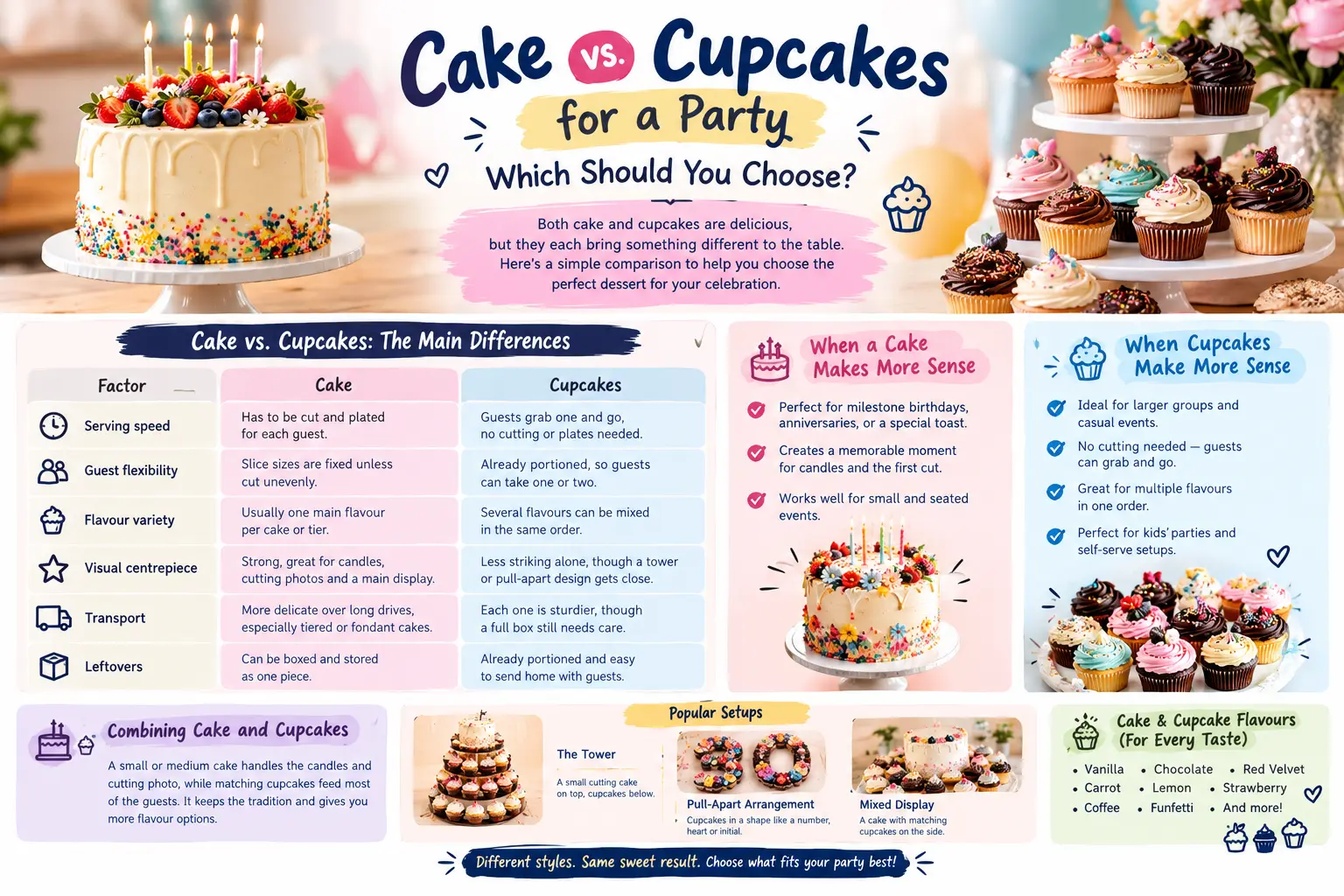
A cake and a batch of cupcakes solve most of the same problem in different ways, so neither one is automatically the better choice. A cake gives a party its centrepiece moment, including the candles, the cutting, and the photos, whereas cupcakes are quicker to serve and let people pick their own portion without anyone slicing anything.
Plenty of parties don't pick one over the other at all — a smaller cake for the ceremony, paired with cupcakes for the crowd, tends to be one of the more practical setups for a mixed-age or larger group. The comparison below walks through serving, cost, flavour variety, transport and setup, so the choice can match the actual event rather than habit.
Cake vs. Cupcakes: The Main Differences
Looking at the two side by side makes the decision much easier, so here's how they compare on the things hosts usually worry about.
|
Factor |
Cake |
Cupcakes |
|
Serving speed |
Has to be cut and plated for each guest |
Guests grab one and go, with no cutting or plates needed |
|
Guest flexibility |
Slice sizes are fixed unless cut unevenly |
Already portioned, so guests can take one or two without anyone cutting |
|
Flavour variety |
Usually one main flavour per cake or tier |
Several flavours can be mixed in the same order |
|
Visual centrepiece |
Strong, great for candles, cutting photos and a main display |
Less striking alone, though a tower or pull-apart design gets close |
|
Transport |
More delicate over long drives, especially tiered or fondant cakes |
Each one is sturdier, though a full box still needs care |
|
Leftovers |
Can be boxed and stored as one piece |
Already portioned and easy to send home with guests |
When a Cake Makes More Sense
The cake is more effective in a scenario where there is one specific time during the party where everyone will be gathered around, such as a milestone birthday, an anniversary, or simply a toast followed by a candle lighting ceremony.
The cupcakes may appear attractive on a table setting, but they do not make that special impact that everyone is waiting to watch the first cut of the cake. The cake can fit well with small and seated events where one person cuts the cake while passing the plates to all people without stopping anyone.
When Cupcakes Make More Sense
With an increase in the number of guests and a less formal atmosphere, the arrival of cupcakes brings great ease into life. Consider a schoolroom party, an office party, or a casual party in a garden where the guests are standing and talking rather than seated at tables. There is no need to pause and cut a cake, which becomes especially important when there are 30 to 40 people.
It also becomes useful in catering to different tastes since a single order can have 2 or 3 flavors and one can choose the flavor they wants. It also make sense for children's parties since each cupcake is pre-portioned; hence, no one gets too big or too small of a piece of cake.
Combining Cake and Cupcakes
Plenty of parties skip the choice altogether and serve both, which is one of the easiest and most popular ways to handle dessert. A small or medium cake takes care of the candles and the cutting photo, while matching cupcakes feed most of the guests, so you keep the tradition without anyone slicing cake for an hour. It also gives you room to play with flavour, for example a classic vanilla cake alongside chocolate or red velvet cupcakes. These are the setups we see most often:
- The tower: A small cutting cake sits on the top tier of a cupcake stand, and individual cupcakes fill the tiers below it.
- Pull-apart arrangement: Frosted cupcakes are placed together in a shape like a number, a heart or an initial, so it looks like one design until guests start pulling pieces off. Number cupcakes made around an age or an anniversary year are a favourite version of this.
- Matching themes: The cake and cupcakes share the same frosting colour, sprinkles or toppers, so the whole dessert table looks planned together instead of like two separate orders placed side by side.
Guest Count, Cost and Flavour
Once you know whether you need a cutting moment, the rest of the order usually comes down to three things: how many people are eating, how much you want to spend, and how many flavours your group needs.
Guest Count
Cake and cupcakes are portioned differently, and that difference grows with the size of the party. A cake serves a set number of people depending on its size, shape and how it's cut, so it's best to plan around the people who'll actually eat dessert and not the full guest list.
Our cake size guide breaks this down by shape and size if you'd like exact numbers. Cupcakes are more forgiving, because a few extras never really go to waste. Someone takes one home or a guest goes back for a second, and there's no cutting to get wrong on the day.
In a general rule of thumb, it is fairly manageable to serve cake to about 20-25 individuals, since cutting the cake remains simple up to that amount of people. For larger numbers than this, cake and cupcakes together will prove to be better options, considering that guests are socializing at the party. However, this is not set in stone and with some preparation and help, a cake can be served to 50 people.
Cost
The price of each depends on the complexity of the design, size, and variety of flavors. In the case of a smaller group, the cost per person for a simple cake will be cheaper compared to cupcakes, since each one requires individual work to decorate it. The price of a more intricate cake that includes the use of fondant, additional tiers, and other decorations rises rapidly, while a cupcake order may become even cheaper. A personalized cupcake set that includes an age or a brief message will be cheaper compared to the cake with the same design at first.
Flavour
With a single cake, the whole group usually eats the same flavour, or one flavour per tier. That's fine when your guests have similar tastes, but it can be a gamble with a big or mixed crowd.
Cupcakes take most of that worry away, because one order can carry two or three flavours side by side and give people a real choice without you ordering several cakes.
Common Dietary Requirements to Know About
Some dietary needs show up at almost every party, so it's much easier to plan for them early than to find out on the day.
Egg Allergies
If a guest has an egg allergy, a regular cake may not be safe for them, so check the ingredients before you order instead of assuming. Our eggless cakes are a good place to start. Keep in mind that eggless only means there's no egg, and the cake may still contain dairy, so if someone also needs to avoid dairy, a vegan option is the better pick.
Nut Allergies
Nut allergies need the most care of the three, because even a tiny trace can cause a reaction, so just leaving nuts out of the recipe isn't enough. What really matters is how the kitchen is run, including the cleaning routine and whether separate equipment is used. That's why it's worth checking a bakery's nut-free cake process first when a guest has a known nut allergy, and the same goes for custom orders.
Lactose Intolerance
Lactose intolerance works differently, since it affects digestion and not the immune system, and the amount of dairy a person can handle varies a lot from one person to the next. Regular buttercream or a milk-based sponge might not agree with them, so our lactose-free cakes are a good option when a guest needs one.
The good news is that none of these needs have to hold back the design. You can choose your flavour and decoration first and confirm the dietary requirement once the rest of the order is settled.
Transport, Storage and Setup
Getting It There
The transportation of a cake requires more care when compared to cupcakes, particularly if the cake is large or layered. This is due to the need to keep the cake flat and undisturbed in its box in order to prevent movement that can cause it to get smeared while moving. Cupcakes have a higher safety margin due to their separate spaces in the box, but the box must be kept horizontal and out of the reach of any direct heat.
Setting It Up
The process of setting up is the same. The cake requires a table, a stand, a knife, a server, forks and plates for all, while the cupcakes will be placed directly on the stand or plate, along with some napkins. As far as leftovers are concerned, they are easy to deal with in both cases – the extra cake can be packed into a single box, while the leftover cupcakes can be taken away by the guests. For an outdoor party or even for a journey to a party from some place far, this factor alone may become decisive.
What About Cake Pops or Mini Cakes?
The cake pop falls into a middle ground between the two. It is a bite-size piece of cake on a stick and can be moved around just as easily, if not easier, than a cupcake and there is no risk of frosting. However, a tray of cake pops is not going to make an elegant centrepiece in the same way a whole cake will. The mini cakes have a similar function and provide a tiny cake for each guest.
Making the Final Decision
|
Type of Party |
Worth Considering |
|
Milestone birthday or anniversary with a cutting moment |
Cake |
|
Kids' party with active, moving guests |
Cupcakes, or a small cake plus cupcakes |
|
Office or corporate event |
Cupcakes, or a small cake plus cupcakes |
|
Wedding or engagement party |
Cake for the cutting, with cupcakes to fill out the dessert table |
|
Outdoor or casual gathering |
Cupcakes, or a smaller cake |
|
Mixed-age family party |
Cake and cupcakes together |
Treat these as a starting point and not a rulebook, because plenty of kids' parties still centre on a decorated cake, and lots of weddings add a cupcake table while keeping the cake too.