


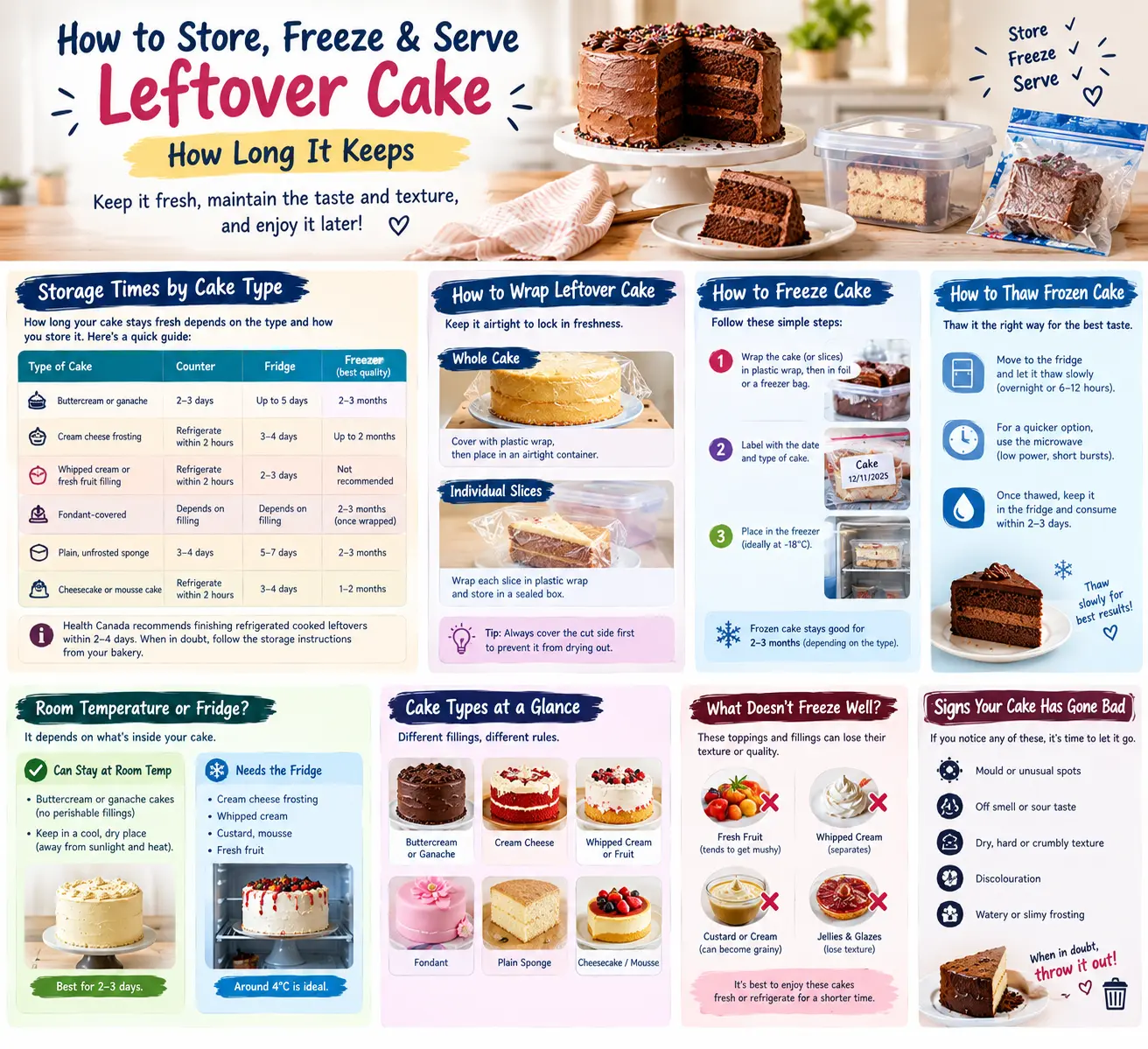
Wrap your slices in plastic wrap and keep them in an airtight box. Buttercream and ganache cakes will last two to three days on the counter and around five in the fridge. Cakes made with cream cheese frosting, whipped cream or fresh fruit need to be refrigerated within two hours and eaten within a few days. A frosted cake that has been wrapped well can go in the freezer for two to three months, and whichever option you pick, the cut side should be covered first.
Use these numbers as a starting point. If your cake came from a bakery, the storage directions it came with should take priority over anything general.
How Long Does Cake Last? Storage Times by Cake Type
The table below assumes the cake has been covered, so expect to lose a day or so if your kitchen runs warm or the wrapping is loose. The freezer column shows how long a cake will still taste good. Food held at a steady -18°C stays safe for much longer than that, which means texture is the real limit once a cake goes into the freezer.
|
Type of cake |
Counter |
Fridge |
Freezer (best quality) |
|
Buttercream or ganache |
2 to 3 days for stable recipes |
Up to about 5 days |
2 to 3 months |
|
Cream cheese frosting |
Refrigerate within 2 hours |
3 to 4 days |
Up to 2 months |
|
Whipped cream or fresh fruit filling |
Refrigerate within 2 hours |
2 to 3 days |
Not recommended |
|
Fondant-covered |
Depends on the filling |
Depends on the filling |
2 to 3 months, once wrapped |
|
Plain, unfrosted sponge |
3 to 4 days |
5 to 7 days |
2 to 3 months |
|
Cheesecake or mousse cake |
Refrigerate within 2 hours |
3 to 4 days |
1 to 2 months |
Health Canada's guidance is to finish refrigerated cooked leftovers within two to four days, and we'd aim for the early end of that range whenever there's cream, custard or fruit inside. A fondant covering won't give you any extra time either, since it's the filling underneath that decides how long the cake stays safe.
Should Cake Be Stored at Room Temperature or in the Fridge?
Cakes That Can Stay Out
A buttercream or ganache cake with nothing perishable inside will sit happily on the counter for a couple of days, as long as it's under a dome or in an airtight container. Try to find a cool corner of the kitchen where the oven and the afternoon sun can't reach it. If you leave it uncovered overnight, the sponge will already be drying out by breakfast, and our guide to cake turning dry explains more about wrapping and storage if this keeps happening to you.
Cakes That Need the Fridge
Cakes with cream cheese icing belong in the fridge, and the same goes for anything made with whipped cream, custard, mousse or fresh fruit. Around 4°C is ideal. You'll probably notice that the cold changes the cake a little, as the sponge tightens up and the buttercream turns firm and slightly flat in flavour. Taking your slice out about half an hour before you want to eat it brings most of that softness and taste back.
Serving Cake at a Party
Whereas in the situation where the cakes have perishable products, the countdown starts once the cake is removed from the refrigerator irrespective of whether the candles have been blown or not. It applies the same rule for the birthday cake on the table in the buffet as the potato salad placed adjacent to it. Once the guests have consumed their shares, the remaining ones can be saved and served in the evening.
How to Store a Cut or Whole Cake
Cover the Cut Side Before Anything Else
The cut edge is the first part of a cake to go stale, and if it's left open, you'll feel the difference by the next morning. Before the lid goes on, press a piece of plastic wrap or parchment flat against the exposed sponge. When there's no wrap left in the drawer, an old baker's trick works well instead: pin a slice of plain bread to the cut face with a couple of toothpicks. The bread gives up its moisture so the cake can keep its own, and you can simply throw it away when you cut the next piece.
Whole Cakes and Single Slices
A complete cake can be packed best in either a cake box or a taller box with a lid that leaves space from the frosting part. In case of individual pieces, extra caution should be taken since they tend to dry up much faster, and as such, they have to be wrapped individually and placed in a small box separated by a sheet of parchment paper. In case the frosting part is soft, the cake should be refrigerated for 15-20 minutes before packaging.
Small Things That Make a Difference
Buttercream picks up smells quite easily, so a cake stored beside half an onion might taste faintly of it by the next day. Giving the cake a shelf of its own helps if you have the space. Before it goes into the fridge, remove the candles and toppers along with any fresh flowers, which can leave damp marks on the icing overnight.
Can You Freeze Cake?
Most buttercream and ganache cakes freeze well, provided they're wrapped properly and your freezer is set to -18°C or colder.
Freezing Slices
Slices are the easiest thing to freeze, because you can take out one at a time and each one thaws in just a few hours.
In our experience, frozen cake usually goes wrong at the wrapping stage. If a slice is wrapped while the frosting is still soft, half of it tends to end up stuck to the plastic. Twenty to thirty minutes in the fridge is enough to firm it up, although you can also leave the slices uncovered on a tray in the freezer for about an hour if your fridge is already full. After that, wrap each slice snugly and add a layer of foil over the top, or pack the wrapped slices together in a heavy-duty freezer bag. It's a good idea to write the date on the bag too, since frozen cake tastes best within two to three months and it's easy to forget when it went in.
Freezing a Whole Cake or Tier
Similarly, an entire cake undergoes a procedure that is quite similar. Cool the cake until the frosting is hardened, cover it with plastic twice, and put it in a box so as not to get dented by bags of frozen peas. There are many couples who have preserved the top part of the wedding cake in such a manner; however, different recipes react differently to freezing, and thus, it is always wise to follow any recommendations made by the baker.
What Doesn't Freeze Well
We'd keep cakes with whipped cream or fresh fruit out of the freezer altogether. Whipped cream slumps as it thaws, and fruit leaks its juice into the sponge until the whole thing turns soggy. These cakes are much happier in the fridge, where they should be eaten within a few days. Cheesecake and mousse cake can be frozen for a month or two, but after that the texture starts to turn grainy.
How to Thaw Frozen Cake Safely
Anything with a perishable filling should be thawed in the fridge. It's the safest option, and the cake thaws more evenly that way as well, which is the same approach Health Canada recommends for food in general.
|
Item |
Best thawing method |
Approximate time |
|
Single slice |
In the fridge, still wrapped; unwrap to serve |
A few hours |
|
Whole frosted cake |
In the fridge, left in its wrapping |
Overnight |
|
Fondant-covered cake |
In the fridge, left in its box or wrapping |
Overnight |
|
Unfrosted layers |
In the fridge, still wrapped |
A few hours |
Leave the wrapping on until the cake has thawed right through, so that any condensation settles on the plastic and the frosting or fondant stays dry. Once it's ready, unwrap it and let it sit on the counter for 30 minutes to an hour before serving. We wouldn't use the microwave, as it heats unevenly and can leave the crumb rubbery. And once a cake has fully thawed, particularly if it has been sitting out for a while, it shouldn't go back into the freezer.
How Frosting and Fillings Affect Cake Storage
Fondant Cakes
Fondant doesn't handle moisture well. If you carry a cold fondant cake straight into a warm room, it will start to sweat, and little beads of water will form across the surface. Keeping it in its box until it reaches room temperature prevents this. Our article on fondant and buttercream compares how the two finishes cope with heat and storage, if you'd like to read more.
Cream, Custard and Fruit Fillings
Fillings differ more than most people expect. Custard, fresh cream and most fresh fruit need to stay in the fridge, while jam and other sugary fillings can handle much more time out. Buttercream and ganache depend on the recipe, so it helps to read the instructions that came with your cake. The cake filling guide covers how each type responds to temperature, and your baker can tell you exactly how long that particular cake can be left out.
Picking Up a Cake on a Hot Day
On a hot GTA afternoon, a parked car heats up very quickly. Buttercream softens within minutes and whipped cream softens even faster, so a cream cake shouldn't be left waiting in the car while you pop into the grocery store. Put the box somewhere flat, such as the trunk or the floor of the car, because seats slope and the cake can slide. Keep the air conditioning running on the way home, and if the cake needs chilling, get it into the fridge as soon as you walk through the door. Whipped cream cakes are generally kept at 1°C to 4°C, and the bakery's handling instructions will tell you whether yours needs anything else.
How to Tell When Cake Has Gone Bad
Leftover cake shouldn't be judged by its looks alone, because time and temperature tell you far more about whether it's still safe. Health Canada also points out that unsafe food can smell and taste completely normal.
If there's any mold at all, the whole cake needs to go, even when the spot is tiny, since cutting around it won't make the rest safe to eat. The same applies to a filling that has turned slimy or watery or has started to separate. When nobody can remember how long the cake has been sitting out, it's better to throw it away than to take the risk.
A hard, dry crumb is a different case altogether. It simply means the cake has gone stale, which affects the taste but doesn't make it unsafe.