

A cake turns out dense or dry for a handful of reasons, and they're rarely obvious ones. The ratios might be off, batter got mixed too much, leavening lost its strength, or the oven ran hotter or colder than the recipe assumed. Most of these mistakes hide in plain sight, too, because the batter looks completely normal right up until the cake comes out of the oven.
This guide walks through the real causes behind a dense crumb and a dry one, how to tell them apart, and what actually helps once you know which one you're dealing with.
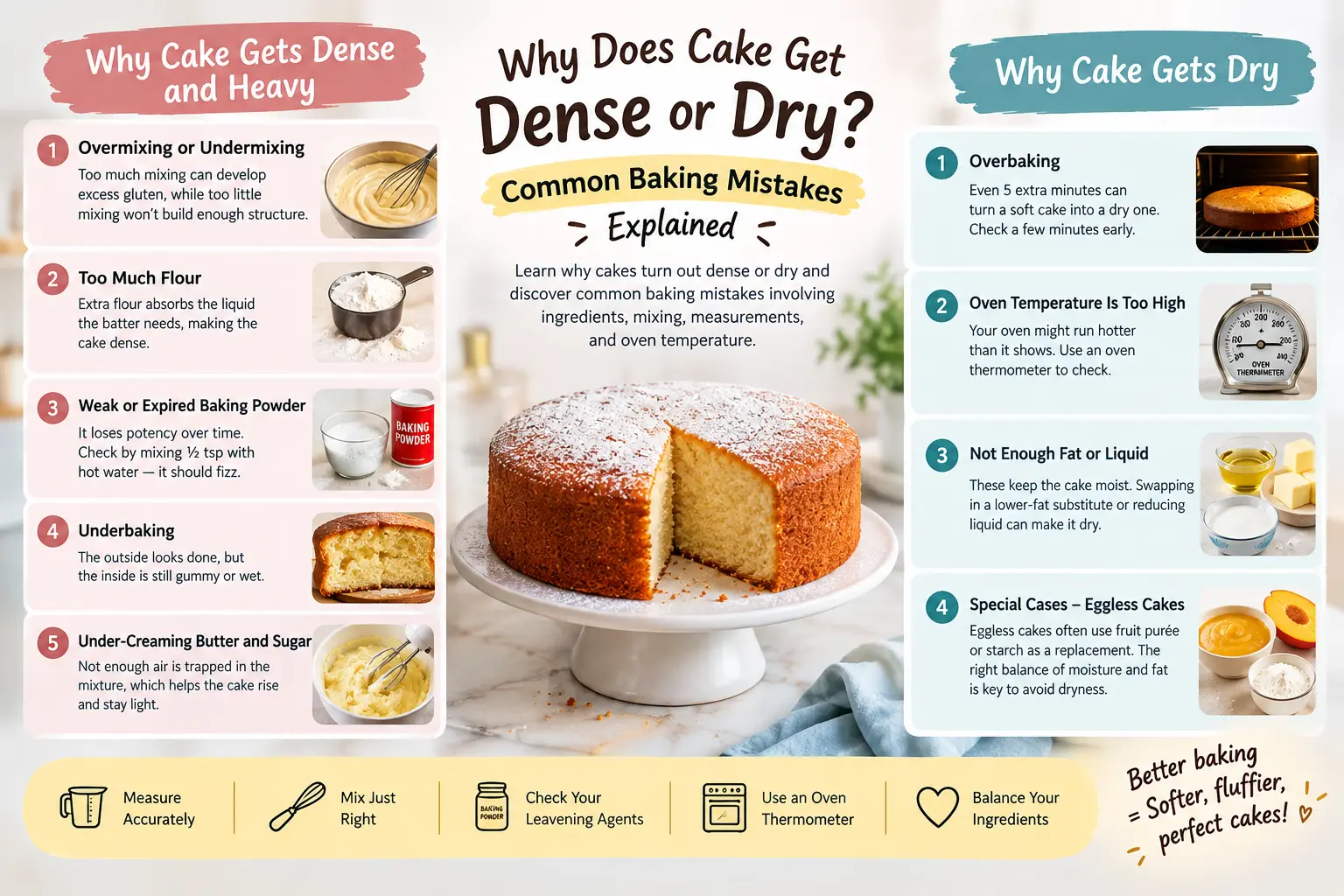
Why Cake Gets Dense and Heavy
Overmixing or Undermixing
Gluten is what holds a cake's structure together, and it forms the moment flour meets liquid and gets stirred. A little gluten is good - it's what lets the cake hold its shape and rise. Push past that point, though, and the crumb turns tight and almost chewy. That's overmixing.
There's a version of this that goes the other way, too. A batter that isn't mixed enough never builds the structure it needs to hold its rise, and the result can end up just as dense as an overmixed one. A heavy cake on its own doesn't tell you which mistake happened - it could be either.
Too Much Flour in the Batter
Excess flour is one of the more common reasons a cake ends up dense, because it soaks up liquid the batter needed elsewhere. It's usually not a recipe problem so much as a measuring one.
Weak or Expired Baking Powder
Baking powder loses potency with time, and faster still once it's been exposed to any moisture - a damp spoon dipped back into the container is enough. A cake can be measured to the gram and still fail to rise properly if the chemical reaction behind that rise has already weakened.
You can check this before you bake rather than finding out after: stir about half a teaspoon into a splash of hot water. It should fizz immediately and fairly vigorously. A slow, weak fizz means it's past its best and worth replacing. Baking soda needs a different test, since it only reacts with acid - a splash of vinegar works the same way.
Underbaking
An underbaked cake looks finished from the outside well before it actually is. The surface browns and firms up faster than the centre because heat always reaches the outside first. Cut into it and the middle is gummy or visibly wet - that's the giveaway, but by then it's too late to fix that particular cake.
Under-Creaming Butter and Sugar
This applies specifically to creaming-method cakes, where butter and sugar get beaten together before anything else goes in. The point of that step is to trap tiny air bubbles in the fat, which expand later in the oven and help the cake rise.
The mixture should become noticeably lighter and fluffier before the remaining ingredients go in — exactly how long that takes varies by recipe and mixer, but if it still looks like plain creamed butter after a minute or so, it likely needs more time.
Stop too early, and you've skipped most of the aeration the recipe was counting on, which shows up later as a denser crumb even if every other step was done right.
Why Cake Gets Dry
Overbaking
Five extra minutes in the oven is often all it takes to turn a soft cake into a dry one. It's an easy mistake to make, too, since most home ovens don't give much warning between "done" and "overdone". Start checking a few minutes ahead of the recipe's stated bake time rather than waiting for the timer to go off.
Oven Temperature Is Too High
Home ovens don't always run at the temperature shown on the display. If yours runs hotter than it reads, the cake finishes earlier than the recipe assumed, and leaving it in for the full stated time dries it out even though you followed the instructions exactly.
An inexpensive oven thermometer is the most reliable way to check whether your oven is running hotter or colder than its display suggests.
Not Enough Fat or Liquid
Both affect how moist the finished crumb feels. Swap in a lower-fat substitute without adjusting anything else in the recipe, and the cake typically bakes up drier, because that one change quietly shifts a balance the rest of the recipe depends on.
This shows up often with eggless cakes, which usually swap eggs for a fruit purée or starch-based binder. Done without rebalancing the liquid elsewhere, the result tends to come out denser and sometimes drier at the same time. Vegan cakes take it further, replacing the dairy fat too, which is why they usually need the whole recipe rebalanced rather than just one part of it.
Incorrect Pan Size or Material
Dry edges next to an undercooked centre often point to a pan that's too small for the batter. The extra depth means the centre needs more time, and the edges pay for it while they wait.
Go the other way with too large a pan and the opposite happens: it cooks faster than expected, and sticking to the recipe's original bake time out of habit leaves the cake drier than it needs to be. Dark metal makes either scenario more pronounced, since it absorbs more heat than lighter pans and tends to finish a few minutes ahead of what the recipe assumes.
Improper Cooling and Storage
A cake left uncovered overnight is often noticeably drier by morning. That's because it keeps losing moisture to the air even after it's fully cooled. Wrap it tightly in plastic once it's cool enough to handle, or store it in an airtight container, and that loss slows down considerably.
The fridge is worth a specific mention here, since it's a common instinct that tends to backfire. Unless a cake genuinely needs to be chilled - cream cheese frosting is the usual reason - refrigeration often dries it out faster than leaving it at room temperature would.
Common Cake Measuring Mistakes
Flour measurement is one of the easiest things to get wrong without realizing it, and it's worth ruling out before changing anything else about the recipe.
Scoop flour directly out of the bag with the measuring cup, and it packs down more than you'd expect. You end up with noticeably more flour than the recipe called for, and that alone can throw off the batter - too much structure, not enough moisture to balance it.
Spooning flour into the cup and levelling it off with a knife gets you much closer to what the recipe intended. Weighing it in grams is more accurate still, since a cup of flour can vary meaningfully depending on how it was packed.
Gluten-free flour blends add another layer to this. Without the gluten network that regular flour builds, they typically need a gum or starch added just to hold the crumb together - skip that, and it tends to show up as dryness or crumbliness rather than density.
Liquid ingredients have their own version of this problem. They need to be measured at eye level in a proper liquid measuring cup, not a dry one - the shapes are different enough that eyeballing it in the wrong cup skews the result more than people expect.
If your cake keeps coming out wrong in the same way every time, this is usually the first thing worth checking before touching anything else.
Cake Texture Troubleshooting: Symptoms and Causes
|
Symptom |
Likely Cause |
What to Check |
|
Dense, heavy crumb |
Overmixing, too much flour, weak leavening |
Mixing time, flour measurement |
|
Dry, crumbly texture |
Overbaking, too much flour, not enough fat |
Bake time, ingredient ratios |
|
Gummy or wet centre |
Underbaking, undermixing, excess liquid |
Doneness test, batter consistency |
|
Tough or chewy bite |
Overmixing, too much flour |
Mixing technique |
|
Cake rose then sank |
Excess leavening, overmixing, underbaking |
Leaven amount, mixing time, bake time |
|
Dry edges, moist centre |
Oven accuracy, pan size or material, batter depth |
Oven thermometer, pan choice |
How to Tell When a Cake Is Done
- Toothpick test - insert it into the centre. It should come out clean or with just a few moist crumbs, depending on the recipe. Wet batter clinging to it means it needs more time.
- Visual check - the cake should just be starting to pull away from the pan's edges on its own.
- Touch test - press gently in the centre. It should spring back rather than leave a dent behind.
None of these are foolproof on their own. Using two together, rather than relying on any single test, gives a much better read on what's actually happening inside the cake.
Can You Fix a Dense or Dry Cake?
It depends which one you're dealing with. A dense or gummy cake is largely a lost cause at that point - the crumb structure is what it is, and there's no fix that changes it after baking. A dry cake has more give.
Brushing the layers with a simple syrup (equal parts sugar and water, sometimes with a splash of vanilla or citrus) while the cake is still slightly warm adds back moisture without making it soggy, since the cake absorbs it gradually rather than all at once.
A moist filling or a generous layer of frosting can mask dryness fairly well too, particularly in a layer cake where each bite includes some filling. For something further gone, turning it into a trifle - cubed, layered with custard or whipped cream and fruit - hides dryness almost completely, since the added moisture has time to soak through properly rather than sitting on the surface.
None of that restores the cake's original texture. What it does is make it enjoyable to eat. For the next attempt, adjusting the recipe or the technique will get you further than trying to rescue this one.