

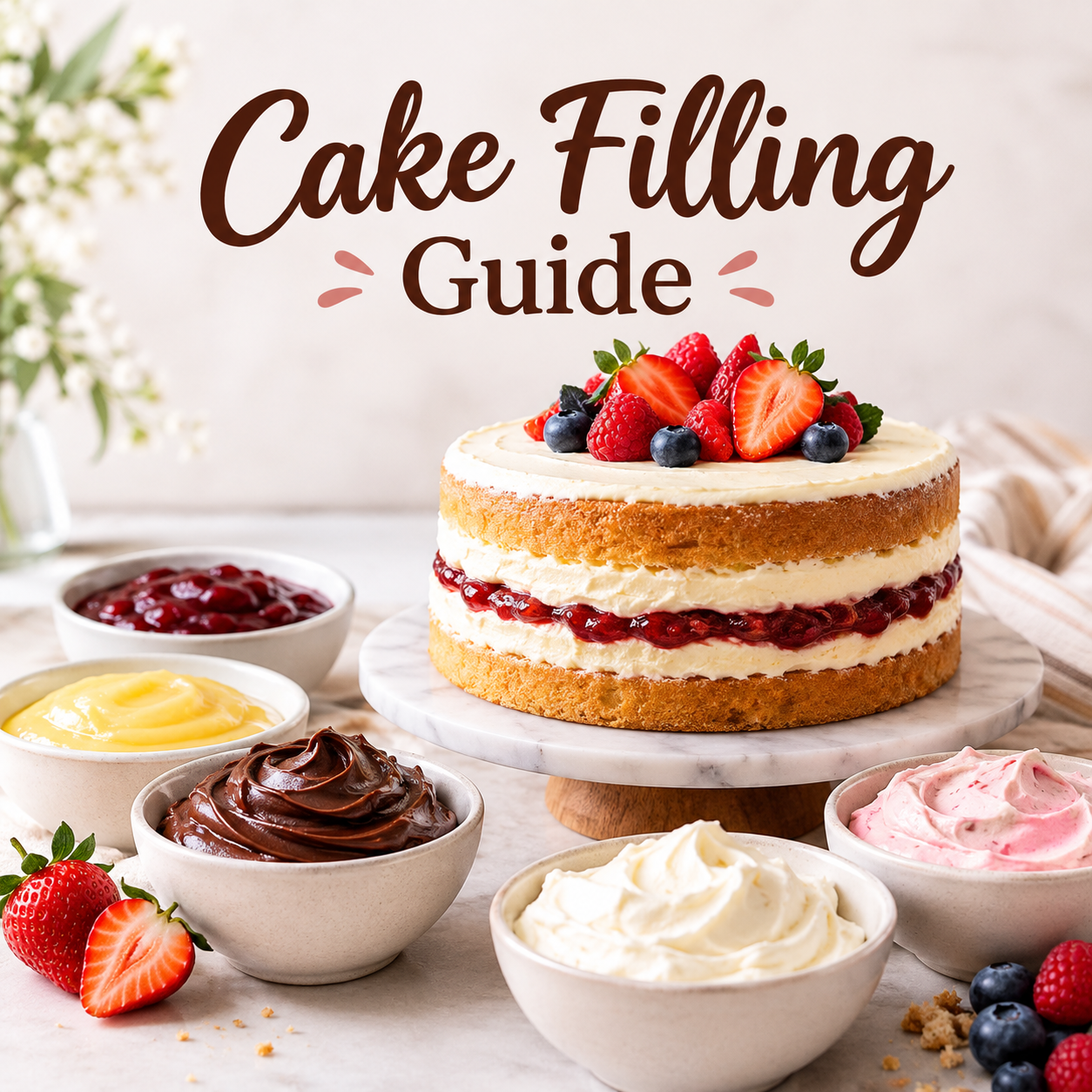
A cake can have the right sponge and the right finish and still feel different depending on what's between the layers. A tart fruit filling can sharpen a rich chocolate cake. Ganache can turn a plain sponge into something that feels far more substantial. Buttercream, custard, mousse, fruit fillings, they all bring something different to the middle of a cake. Worth thinking through, not just defaulting to whatever's easiest.
Quick Answer
There are several different types of cake fillings that can be found including buttercream, ganache, fruit filling such as compote or curd, custard or pastry cream, cream cheese, mousse. Of course, the type of filling that will work is dependent on the taste of the cake itself, its texture and how it is going to be kept after preparation. The rich flavor of chocolate cake should be balanced out by a tart one. Mousse lightens the cake while ganache makes it dense and heavy.
Types of Cake Fillings
There's what a filling tastes like on a spoon, and what it actually does once it's sandwiched between two layers of cake and it is not always the same thing. Plenty of fillings taste amazing on their own and still ruin a slice, too sweet, too heavy, fighting the cake instead of sitting alongside it. Six options come up again and again, and each one changes a cake differently including weight, richness, how the bite actually feels, not just flavour.
Here's a look at the six types worth knowing:
1. Buttercream: It doesn't try to steal the show. It just backs up whatever the cake's already doing, adding sweetness without getting in the way of the flavour underneath. Same texture whether you're using it as a filling or the outer frosting. Coffee, fruit, a swirl of jam folded through, any of that pushes it further than people expect from something this plain.
2. Ganache: Texture is really what sets ganache apart from buttercream. Chocolate and cream, melted together, set anywhere from a thick sauce to a firm spread depending on the ratio. Dense and glossy, not airy. Dark chocolate ganache gives contrast against a lighter cake. Milk or white chocolate leans sweeter, and it needs a flavour underneath that can actually hold up against it.
3. Fruit-Based Fillings: Rich chocolate or vanilla cakes usually want something sharper in the middle, and fruit fillings cover more ground than people expect. A compote is cooked fruit that hasn't fully broken down, so there's still texture along with the flavour. A curd, lemon curd being the obvious one, is smoother and tangier, closer to a thick custard than a jam. A preserve sits in between, sweeter than a compote, not as sharp as a curd. How much acidity any of them bring comes down to the recipe, but that sharpness is usually the whole reason they end up next to something heavier.
4. Custard and Pastry Cream: Less common than buttercream or ganache as a filling, mostly because it needs more careful handling. What it gives back is a smooth, creamy texture that nothing else on this list quite matches, not the airiness of mousse, not the density of ganache. Vanilla's the standard. Chocolate and coffee versions work the same way.
5. Cream Cheese: Carrot cake and red velvet, that's what people picture when the second cream cheese filling comes up, and once you actually taste it together it's obvious why. The tang cuts through sweetness in a way buttercream just can't, which matters on a cake that's already sweet enough without more sugar piled on top. It spreads about the same as buttercream, smooth, easy to work with. Flavour's really where the two differ.
6. Mousse: Whipping air into a filling changes more than people expect. That's the whole difference with mousse: the lightness comes from air, not from using less of anything. Chocolate mousse still tastes indulgent. Fruit mousse works the same way, real flavour without piling on weight.
How to Choose a Cake Filling
|
If the Cake Is... |
Consider... |
Why |
|
Rich or chocolate-heavy |
Fruit filling or mousse |
Adds contrast instead of more richness |
|
A simple vanilla sponge |
Custard, fruit, or mousse |
Gives the cake a stronger flavour direction |
|
Already strongly flavoured |
A complementary filling in the same direction |
Reinforces the flavour instead of competing with it |
|
Being transported or stored before serving |
Whatever suits the specific recipe's stability |
Timing and storage matter more than flavour here |
Matching Filling to Cake Flavour
Two ways to go here: contrast or complement.
Contrast means picking a filling that pushes against the cake instead of echoing it, the way a tart raspberry filling keeps a rich chocolate cake from feeling one-note. Complement goes the other way, doubling down on a flavour so the whole thing reads as more of the same, coffee filling inside a coffee cake, vanilla custard inside a plain vanilla layer.
Neither one's the better strategy overall. Depends what the cake already is. Browsing the full flavour range helps here, since seeing what's actually on offer makes it easier to decide whether the filling should echo that or work against it.
How Filling Texture Changes the Eating Experience
Flavour gets all the praise, but texture is equally important when it comes to eating that filling, after it has gone into the cake. Filling like ganache and butter cream, which are heavy, fall on the other side of the spectrum and suit a cake, where a little is enough. Put that kind of heaviness in a large slice of a heavy cake, and the result will be overpowering.
Mousse solves that problem by adding volume instead of weight. Air does the work density usually does, so a mousse-filled cake can taste just as indulgent without sitting as heavy afterward.
Then there's the question of consistency. Custard and curd spread smooth, the same bite from edge to edge every time. Fruit compotes and anything with actual pieces in it break that up on purpose. Some cakes want that unevenness while others don't.
Storage and Travel Considerations
Storage really comes down to the specific recipe more than the general category, so there's no clean rule that covers everything. Buttercream and ganache can vary a lot in how stable they are at room temperature, formulation and dairy content both matter. Anything with dairy, egg, or fresh fruit generally needs more careful refrigeration than the firmer, sugar-based fillings, and custard or pastry cream is the most temperature-sensitive of the whole group, usually needs to stay cold right up until serving.
If a cake has to travel or sit out a while before it's cut, asking directly how that specific filling should be stored, and how long it's safe without refrigeration, beats just assuming a general rule applies.
Conclusion
It is another of those decisions that is easy to put in an afterthought category and certainly deserves more consideration. Once the filling has been isolated from what goes on in the cake's exterior, it all boils down to a very few considerations: its taste as opposed to the cake, whether the filling should be light or should provide some substance, and whether the cake has to keep for a few hours before cutting into it. If you have these three covered, everything else will follow suit.