
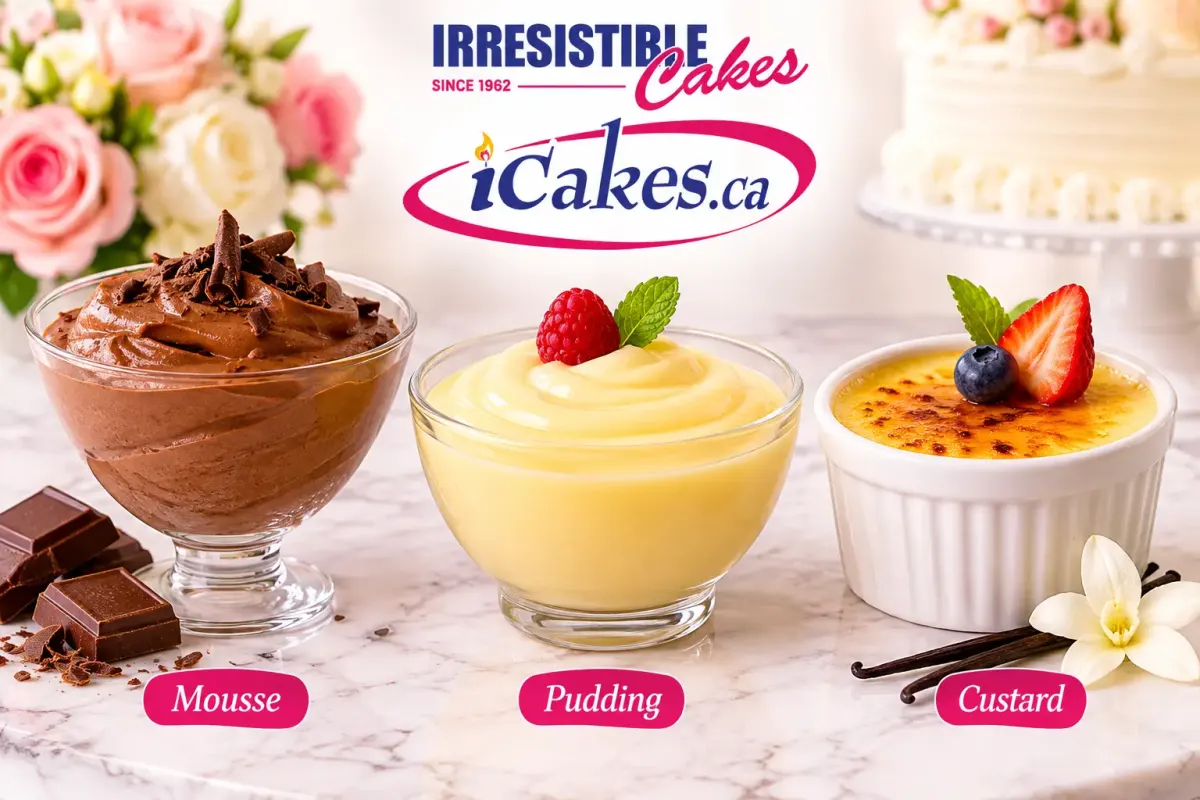
The difference between mousse, pudding and custard lies mainly in how they develop their structure and texture. Mousse is an aerated dessert, made light with whipped cream or egg whites. Pudding is commonly thickened with starch or other thickening agents. Custard is traditionally thickened with eggs. Recipes vary, and the categories overlap, so some desserts combine features of more than one.
What Is Mousse and What Gives It Its Airy Texture?
The mousse dessert is made up of an airy product that is created by incorporating air into a flavored base. Mousse is a French word for foam because that is precisely what it is when made. Cream is often used to aerate the product, while other things like chocolate can be added for stability.
Common Ingredients in Mousse
The most common combinations are a flavoured base with an aerating agent. The base could consist of melted chocolate, fruit puree, or even a flavoured custard. Some common components are:
- Whipped cream, which provides bulk
- Whipped egg whites or meringue, providing light texture
- Egg yolks or whipped egg and sugar mixture, providing richness
- Gelatin, which helps give form to the fruit and cream-based mousses
How Air Is Incorporated
Cream whipped to soft peaks gives a rich, velvety mousse, while whipped egg whites give a lighter, foamier one. Some recipes use both. Usually, the aerated component is folded into the base rather than stirred, because vigorous mixing knocks out the bubbles that give mousse its character.
Why Mousse Feels Lighter Than Other Creamy Desserts
The bubbles of air in the mix make it less dense, making each serving lighter. There are different ways in which whipped cream and egg whites form stable bubbles of air, and in some recipes, cooling, chocolate, or gelatine can aid in maintaining the shape of the mousse. This is why mousse seems to melt in the mouth in a way that no denser pudding or custard can.
Mousse is usually served in cups or glasses, where its soft texture can be served alongside other ingredients. One such dessert is that of a layered mango mousse.
Mousse Is Not One Fixed Recipe
While some older-style chocolate mousses incorporate raw eggs, newer types either cook the egg or omit it altogether, instead relying only on whipped cream. Some are stabilised by the addition of gelatin, whereas some simply set themselves cold. Common to all of them, however, is the aerating of ingredients.
What Is Pudding and How Does It Thicken?
In this comparison, pudding is used in reference to the dessert pudding made from milk, sugar, flavorings, and a starch such as cornstarch cooked together until thickened. There are many different definitions of pudding in British and other cuisines that will be discussed below.
Typical Ingredients in Pudding
- A stovetop pudding does not require many ingredients:
- Milk, or milk and some cream, as the liquid
- Sugar as sweetener
- Thickener, which is usually starch
- Flavoring such as vanilla, chocolate, or caramel
- Eggs, or egg yolk and butter in rich recipes
How Starch Thickens Pudding
In liquid form, starch swells and absorbs water when heated up. The structural change causes thickening of the liquid and conversion of thin milk to a thicker one. This is referred to as the process of gelatinisation. The extent of thickness attained by the mixture is determined by various factors including the type of starch used, the temperature, and the cooking method used.
Pudding Covers More Than One Kind of Dessert
Not every pudding follows this method. Some contain eggs as well as starch, and others are baked, like bread pudding, or named for their main ingredient, like rice pudding. Steamed sponge puddings are another category altogether. These desserts share a name and a tradition, not a technique.
What Is Custard and How Do Eggs Create Its Texture?
Custard is a dessert or sauce made from milk or cream, sugar and eggs, with the eggs acting as the thickener. Both whole eggs and yolks are used. Yolk-heavy custards tend to be richer and silkier, while those made with whole eggs usually set a little firmer.
The Role of Egg Proteins
The eggs are heated gently, allowing the proteins to unravel and bind with each other. This network helps to trap the milk or cream; this results in a thick liquid mixture which can coat the spoon. The ratio of eggs to liquids is what makes the custard firm.
Why Temperature Control Matters
Usually, stirred custards are cooked over a very mild flame since the actual temperature of the custard rises to about 80–85° Celsius (176–185°F). The ratio of eggs to liquid, and even the presence of any sugar in it, may alter the exact temperature at which the custard. Overcooked custards may result in the coagulation of the proteins, resulting in the release of excess moisture, thus resulting in curds. This situation is avoided by maintaining low heat and constant stirring and checking the thickened texture by using a spoon test.
Stirred Custard vs Baked Custard: Two Common Methods
There are two main ways to make custards, which depend on the way heat and agitation are introduced.
Stirred custard is heated in a pan on a stove while being stirred continuously. The agitation prevents the proteins from forming one mass, resulting in a pourable or lightly thickened custard. An example of a stirred custard is crème anglaise, which is often served with desserts.
Baked custard is made without agitation in an oven. Baked custard is usually heated with the help of a water bath, which gives slow and even heating. The proteins are permitted to set up completely, making a delicate gel, which may be scooped out. Crème caramel, pots de crème and baked egg custard tarts use this technique.
The texture of the custard depends on the proportion of eggs, dairy product and the time of cooking.
Mousse vs Pudding vs Custard: What Are the Main Differences?
The table below summarises typical characteristics. These are general patterns rather than universal rules, and individual recipes can differ.
|
Characteristic |
Mousse |
Pudding (American-style) |
Custard |
|
Main thickening or texturising method |
Aeration, with ingredients such as chocolate or gelatine helping support the structure |
Starch or other thickening agents; sometimes eggs as well |
Egg proteins set by heat |
|
Common ingredients |
A flavoured base such as chocolate or fruit, whipped cream or egg whites, sugar |
Milk, sugar, flavouring, starch such as cornstarch |
Milk or cream, eggs or yolks, sugar |
|
Preparation method |
An aerated element is folded into a prepared base, then usually chilled |
Milk and starch are heated and stirred until thick |
Stirred on the stove or baked gently, often in a water bath |
|
Typical texture |
Light, airy, soft |
Smooth, dense, spoonable |
Silky and creamy; pourable if stirred, softly set if baked |
|
How air affects the result |
Air is essential and creates the structure |
Little or no air is deliberately added |
Air is not a goal; excess bubbles are usually avoided |
Mousse vs Pudding
The biggest difference is the role of air. Mousse contains deliberately incorporated bubbles that give it a lighter structure. A typical starch-based pudding has little deliberately added air, so its texture is more uniform and dense.
Pudding vs Custard
Starch pudding can withstand higher heat levels compared to custard, which is made using eggs and requires careful heat regulation to maintain its smoothness. This is why custard is considered the more delicate of the two in the kitchen.
Mousse vs Custard
The texture of custard is obtained through the protein setting of eggs through heating, while mousse uses air that has been trapped in it. These methods can also both be used together since there are some mousses which use a cooked custard base.
Why Do Mousse, Pudding and Custard Sometimes Overlap?
Mousse, pudding and custard can share ingredients such as milk, cream, eggs and sugar, but those ingredients do not always perform the same role. As a result, some recipes combine features of more than one dessert. Bavarian cream, for instance, combines a stirred custard with gelatine and whipped cream. A pudding may include egg yolks, and a custard-style filling may be partly thickened with starch. In these cases, the name often reflects tradition or the cook's intention rather than a strict rule.
The same preparations can also be used between cake layers, where their consistency and stability affect how well they function as different types of cake fillings.
These techniques matter in professional baking too, where the preparation of custom cakes and desserts can involve different creams, mousses and fillings that need to hold their intended texture.
Similar Ingredients, Different Preparation Methods
Each shared ingredient changes role from one dessert to the next:
- Eggs thicken a custard, add richness to some mousses, or supply a mousse's air when whipped as whites.
- Cream enriches a custard but is whipped for volume in a mousse.
- Milk is the liquid that starch thickens in a pudding and that egg proteins set in a custard.
- Sugar sweetens all three and can also help stabilise whipped egg whites.
How Regional Definitions of Pudding Differ
The term "pudding" describes various kinds of desserts depending on the geographical area.
American usage: In America, pudding means a smooth, spoonable dessert, usually starch-thickened, such as chocolate or vanilla pudding. Rice pudding and bread pudding are also popular; however, the first association of pudding is the soft one that is cooked on the stove.
British usage: The British term "pudding" is wider. It can describe the dessert course in general, "What's for pudding?" It also describes steamed or baked desserts, like sticky toffee pudding and Christmas pudding, as well as savory foods, such as Yorkshire pudding and black pudding.
American pudding and British custard can have the same consistency, but the methods of cooking differ. Usually, American pudding is made from starch, while British custard can be cooked with eggs or with the use of custard powder, which contains starch.
How to Distinguish Them by Ingredients, Preparation and Texture
When a dessert's name is ambiguous, three quick checks help.
Ingredients: Cream or beaten egg whites signify mousse, cornstarch signifies pudding, and eggs as the primary thickening agent signify custard.
Method: Folded signifies mousse, boiled and stirred is a method used for starch pudding, and slowly cooked in the pan or in a water bath signifies custard.
Texture: Mousse is airy, pudding can be homogeneous, and custard has textures ranging from liquid to soft set.
If the dessert cannot be identified with any specific characteristic mentioned above, then it could well be a hybrid and named after convention.