
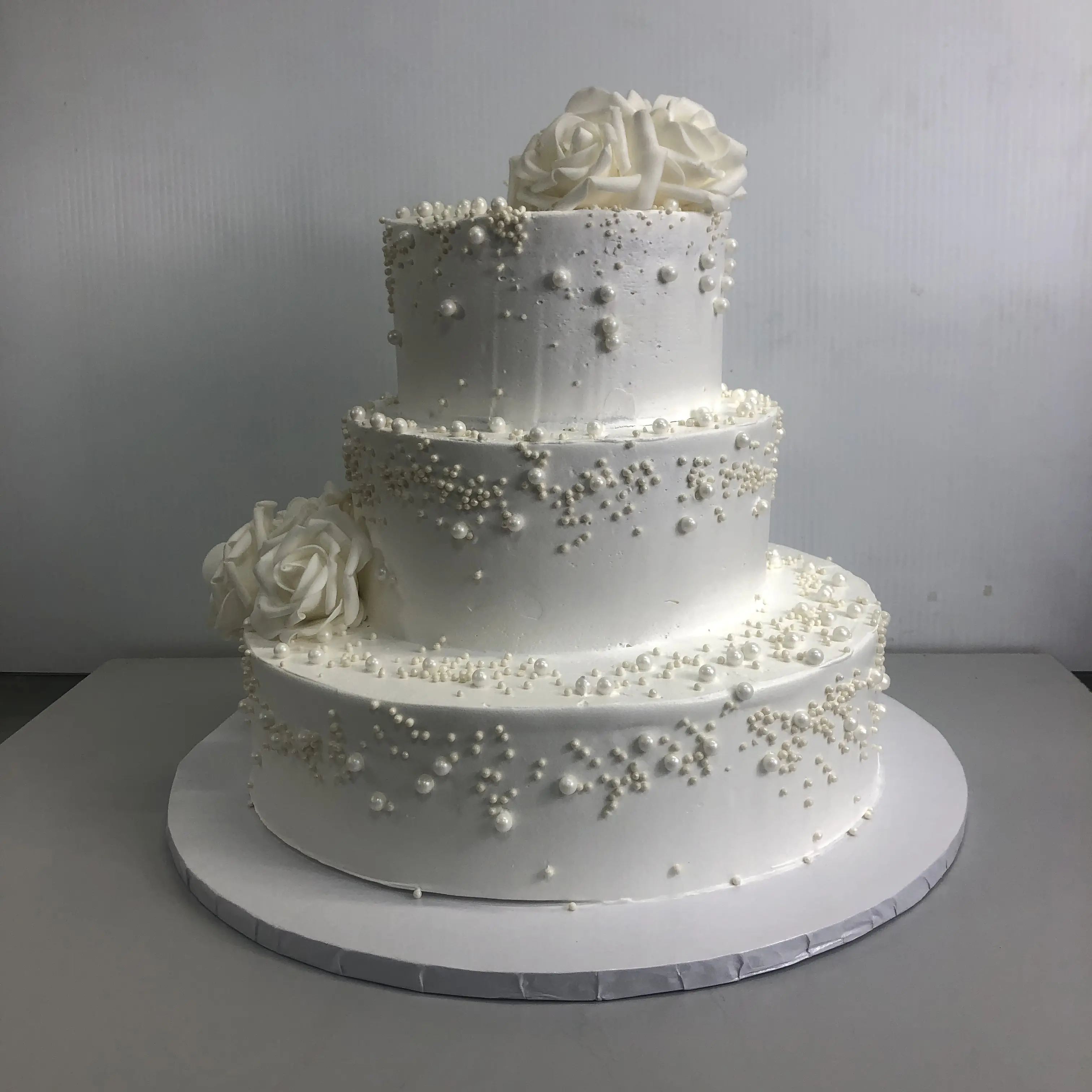
Round tends toward softer, more traditional styling, while square creates a more structured, contemporary look, and modern isn't a shape at all but a design language layered on top of either one for wedding cakes. Style narrows the shortlist, though the final call usually comes down to guest count, venue, cake table space, and budget working together.
This guide walks through all of it, with real examples and real numbers, so the decision comes from something more solid than a single photo saved on a phone.
Quick Wedding Cake Shape Guide
|
If You Want... |
Strong Starting Point |
|
Traditional elegance |
Round |
|
Clean, contemporary lines |
Square |
|
Rustic or natural styling |
Either silhouette, depending on finish |
|
A formal or black-tie look |
Either silhouette, depending on styling |
|
Minimalist design |
Round or square |
|
A dramatic centerpiece |
Asymmetric or mixed tiers |
|
A large reception |
Compare serving capacity by shape and tier count |
|
A small, intimate wedding |
One or two-tier round or square |
|
A unique statement piece |
Hexagon, petal, or mixed silhouettes |
Is Round or Square Better for a Wedding Cake?
Round and square aren't competing for the same job. A curved tier gives cascading florals or a drip finish somewhere continuous to land, which is why round still dominates for a softer design. Square trades that for sharper lines and, more usefully, more cake per tier at the same width. That second part isn't just cosmetic. Past a certain guest count, the shape can mean one fewer tier doing the same work. Pick round for the finish and square when the room's big and every inch of cake needs to count.
What Cake Shape Is Best for Your Wedding Style?
Style narrows the shortlist, though it doesn't settle the question outright. Think classic and romantic: soft florals, round tables, a traditional ceremony. That combination almost always points toward round, often finished with petal or scalloped edges for a gentler look. Flip to something contemporary or industrial, and square starts to make more sense, especially in a venue with exposed brick or minimalist styling, or a geometric touch like hexagon tiers.
Rustic is the tricky one. It doesn't belong to either shape by default. A semi-naked or naked finish can soften round or square, but it reads differently depending on which one you pick, since a curve hides imperfection in a way a flat panel doesn't. None of this locks anything in. It's a starting point, not the answer.
Round Cakes: What They Actually Suit
Vibe: Classic, soft, and timeless.
Best for: Traditional ballrooms and romantic garden receptions, and any design built around continuous floral or piped detail.
Pros:
- The curved surface gives floral cascades, piped detail, and drip icing a continuous line to follow, without the interruption a flat edge would create
- A semi-naked or naked finish tends to look intentional on a curve, since exposed sponge and loose buttercream texture flow with the shape rather than sitting inside a hard edge
- Round tiers are what most serving charts are built around, which makes portioning familiar and predictable
- A simple round design can be less expensive than a comparable square one, since square designs calling for sharp, defined corners tend to need more precision work
Cons:
- At the same tier width, a round cake yields less usable cake area than a square one, since a circle only fills part of the equivalent square footprint
- It can take up more visual floor space on the cake table relative to the servings it provides, compared with a square tier of the same width
A cake like the Briar Rose Three-Tier Wedding Cake, built around gum paste florals over fondant, shows round at its best, with the florals cascading down the tiers without a single hard break in the line.
Square Cakes: What They Actually Suit
Vibe: Structured and contemporary, with a clean, architectural read.
Best for: Contemporary banquet halls, geometric or art deco themes, and large receptions where table space and serving count both matter.
Pros:
- Square tiers carry more usable cake area than round ones of the same width, which is one reason square shows up so often at larger receptions
- The flat faces cut cleanly into even grid portions, which some couples prefer over slicing wedges from a round tier for a big group
- Sharp corners are a natural canvas for geometric patterns, colour blocking, metallic accents, and edible photo panels, since a flat surface doesn't crop or distort a printed image the way a curved one can
- The clean lines suit a structured, formal presentation just as easily as a minimalist one
Cons:
- Achieving crisp, sharp corners in buttercream or fondant takes more time, skill, and material than a round tier of the same size, and that extra work can show up in the price when the design calls for very defined edges
- A soft, heavily textured buttercream finish tends to sit less naturally on a flat panel than on a curve, since loose icing work can read as unfinished on a hard edge in a way it wouldn't on a rounded surface
"Modern" Isn't a Shape, It's a Style
This is worth stating plainly, because it trips up a lot of wedding planning searches. "Modern" describes the overall design language of a cake rather than one specific geometric outline. A contemporary or architectural cake might use hexagonal tiers, or an asymmetric stack where each layer sits off-centre from the one below it, or floating tiers separated by visible gaps or clear acrylic spacers, and it might just as easily mix round and square layers in the same structure or simply put a minimalist finish on an otherwise standard shape. None of those approaches are the same thing as each other, which is exactly why this kind of statement design can't be picked the way round or square can.
The real decision isn't round versus square versus modern. It's choosing a base shape first, then deciding how far to push an unconventional or geometric finish on top of it, since a round cake can look entirely contemporary with the right styling, and a square cake can lean traditional with the right flavour and filling underneath the fondant.
Can You Combine Round, Square, and Geometric Tiers on One Cake?
More couples ask for this than the "pick one shape" framing suggests, and it isn't really one single request either. Some alternate round and square tiers up the stack for contrast, while others pair a round base with a hexagon or petal-shaped top tier as more of a statement piece, and some go further still with an asymmetric arrangement, where tiers of different shapes and heights sit off-centre from each other rather than lining up neatly.
Whatever form it takes, a mixed cake tends to read as less expected than one that sticks to a single outline the whole way up, even when that single shape is decorated just as well.
What Cake Shape Works Best for Small vs. Large Weddings?
Guest count changes the shape of conversation more than most couples expect going in, though there's no fixed cutoff where one shape suddenly becomes wrong. For a smaller, more intimate wedding, a one or two-tier cake is often enough to cover the guest list regardless of shape, so the decision at that scale comes down almost entirely to style rather than serving logistics.
As guest counts climb, the area difference between round and square starts to matter in a real, calculable way. A 10-inch round tier serves roughly 21 to 30 people at iCakes, and the cake size guide breaks the rest down by tier size if the exact count matters. A 10-inch square tier carries meaningfully more usable surface area at the same width, so it stretches further without needing an additional tier or a wider base, which is part of why square, or a taller stack of round tiers, tends to show up more often at a large formal reception than a single wide round base.
How Does Your Venue Affect Cake Shape?
Venue affects the overall aesthetic more than most couples account for early on. Traditional banquet halls are common wedding venues across Toronto and the GTA, and many use round reception-table layouts, so a round cake can echo the shape of the room in the dessert display. A square cake in that same room still works, and some couples choose it specifically for the contrast against an otherwise all-round room, while others prefer to keep the cake consistent with the tables around it.
Outdoor and backyard weddings tend to favour a more relaxed, natural aesthetic overall, which is part of why softer finishes show up so often at that kind of venue, whereas indoor city venues with a more architectural, minimalist look tend to favour square or geometric shapes for a similar reason: the cake continues the room's existing style instead of competing with it. A smaller, more intimate venue, a private dining room or an at-home reception, removes most of that matching pressure entirely, since there's no large room of tables to echo or contrast against in the first place.
How Does the Cake Table Affect Your Shape Choice?
Venue sets the overall aesthetic, while the cake table itself is about whether the physical display actually works. A round cake on a round table reads as one continuous shape from most angles in the room, whereas a square cake on the same table creates deliberate contrast, corners against curves, which some couples want specifically and others find distracting.
Table size matters just as much as table shape. A tall, narrow tiered cake needs less footprint than a wide single-tier design, which becomes relevant in venues with a compact dessert table or a display area shared with other desserts, and backdrop and florals interact with shape too: a round cake against a floral arch tends to blend into a soft, continuous scene, while a square or geometric cake stands out as a distinct element against the same backdrop. None of this changes which shape is "correct," but the table dimensions, height clearance, and surrounding décor are worth mentioning to a cake designer alongside guest count and venue type. It's also worth knowing that a cake's visual height doesn't have to match its serving count exactly, since tier proportions can often be adjusted to balance appearance against how much cake is actually needed.
Does Wedding Cake Shape Affect the Budget?
Shape can influence cost, but it's rarely the biggest factor in the final number. Square tiers can cost more than comparable round ones when the design calls for sharply defined corners and additional finishing work, though a simpler square design doesn't carry the same premium.
Tier count, fondant versus buttercream, and the amount of hand-piped detail or gum paste work all tend to move the price more than shape does on its own, so a round cake with elaborate sugar florals can easily cost more than a plain square cake with a clean buttercream finish, even though square carries its own cornerwork premium when the design calls for it. Where shape does connect to budget most directly is serving efficiency at scale, since a square tier's extra usable cake per width can sometimes mean fewer or smaller tiers are needed to hit the same serving count, which can offset the cornerwork cost for a large guest count. The practical approach is to compare full cake specifications, shape, size, tier count, and finish together, rather than assuming either shape is automatically cheaper.
What to Tell Your Cake Designer Before Choosing a Shape
Walking into a cake consultation with a few specifics ready makes the shape conversation faster on both sides. Worth having on hand:
- Total guest count, and roughly how many are likely to actually eat cake versus other desserts
- Venue type and whether reception tables are round, rectangular, or mixed
- Cake table dimensions and location, including whether it's shared with other desserts
- Preferred tier count, or whether that's flexible depending on shape
- Overall design style, classic, rustic, modern, or a specific theme
- Budget range, and whether that's a hard ceiling or a starting point
- Venue access and setup requirements, since larger or more complex cakes need more careful delivery planning regardless of shape
None of this locks in a final decision on its own, but it gives a designer enough to recommend a shape that actually fits the day, rather than defaulting to whatever's fastest to quote.
How to Choose the Right Wedding Cake Shape for Your Wedding
Bringing the whole decision together in one place:
Choose round for a classic or romantic wedding, a venue set up with round reception tables, or a finish built around soft florals or a semi-naked look.
Square makes more sense once the wedding leans contemporary or architecturally sharp, and it earns its place fast when the guest list is big enough that serving efficiency actually matters, or when the design leans on colour blocking, metallic accents, or a photo panel that needs a flat surface.
Want something nobody else has? That's where a mixed or unconventional arrangement comes in, whether the venue and style genuinely don't point one way or the other, or the couple just wants the cake to feel like a statement rather than a safe pick.
Guest count driving the decision? Run the servings-per-tier math before locking in a shape, because a wide single-shape cake isn't always the most efficient way to feed a full room.
Care more about the venue? Match the shape to the reception tables and the room, or go the other way and choose a deliberate contrast, but don't pick blind without thinking about the space the cake's actually going into.
Budget calling the shots? Look at the full spec, not shape in isolation. Tier count and finish complexity usually move the price more than round versus square ever will.
Still stuck? Start with what's already fixed, the venue, the guest count, the cake table, and once those are locked in, the shape almost picks itself based on whatever the room's already telling you.