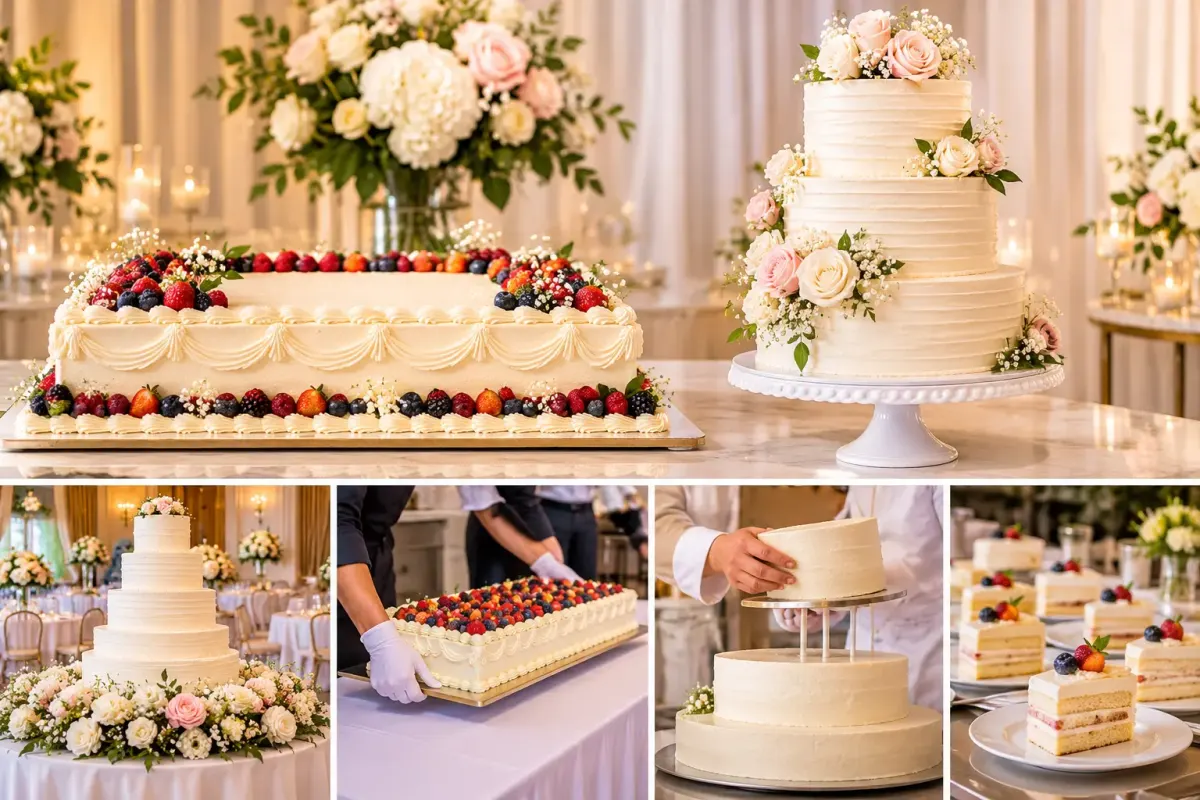
Where a guest list reaches the hundreds, it becomes a logistics decision rather than a dessert one. A sheet cake is made up of one wide, flat piece. A tiered cake rises in stacked pieces; it's often the focal point of the room. In either case, these types of cakes can both serve for a large party - making the issue of a sheet cake versus a tiered cake more of a visual issue, not a tasting one. It comes down to what you want the cake to look like, where the venue can support it, and how the portions get to everyone's plate.
The following is a guide on these three aspects in the sequence that you will likely go through.
Understanding the Difference Between Sheet Cakes and Tiered Cakes
Some background will be useful prior to making the comparison. For help estimating quantities, see our guide to cake sizes and serving portions.
What defines a sheet cake?
A sheet cake is prepared in a rectangular pan and served in the same pan. It is usually one-layer or at most two-layer cake that is decorated on the top with borders, designs or messages. Since the weight of the cake is spread over a large base, a sheet cake does not need an internal support structure like that of a tiered cake.
What defines a tiered cake?
A tiered cake comprises two or more round, square or hexagonal cakes that reduce in size from the bottom to the top and are stacked one on top of the other. The cakes rest on separate boards, while support structures such as dowels hold up the tiers of the cake. It is this structure that keeps a tall cake standing.
How their structures and presentation differ
|
Feature |
Sheet cake |
Tiered cake |
|
Shape |
Wide and low |
Tall and narrow |
|
Internal support |
Usually none beyond a base board |
Cake boards and internal supports, such as dowels or support rods |
|
Visual impact |
Practical, understated |
Formal, sculptural |
|
Where the weight sits |
Spread across a large base |
Concentrated on a smaller footprint |
|
Typical handling |
Carried flat in a box |
Often moved in sections |
The tall, narrow shape is exactly why tiered cakes behave so differently once they leave the bakery.
How Sheet and Tiered Cakes Are Handled at Large Events
Where the formats differ the most is in handling, and it is something that is overlooked until the time of delivery.
Moving and positioning
Sheet cake is transported in a rectangular box, and the difficulty is transporting it horizontally. A sheet cake is not particularly high, but it is difficult in its width and more heavy than it seems, so larger sheet cakes require two people to carry them comfortably through doors and corners.
A tiered cake is a completely different story. A lot of bakeries transport tiers separately, on a non-slippery surface in a cool car, and assemble them at the venue. Some bakeries transport small tiered cakes already assembled. In any case, a brake, a bump on the road or a warm car may affect a tall cake differently from a flat one.
Why tiered cakes need structural support
Each layer pushes on the one below it. Without dowels and boards, the lower layers are compressed, buttercream becomes pushed out, and the entire cake is prone to leaning. Soft fillings, heavy fondant, and warm environments make things even harder. That's why cake stability is an issue of structure and temperature, rather than decorating.
When assembling a tiered cake, you also need a firm, flat foundation. If your table tips even slightly, then it will accentuate any lean on the tower, and that's as important as the cake.
Why sheet cakes need the right surface
Handling sheet cakes does not have an issue with the height problem, but it presents a challenge in terms of space. The big, rectangular-shaped cake requires a long, flat, and strong table where it can be placed. This kind of cake can break if placed on a folding table which is prone to bending in the middle, or on a counter that is shorter than the cake itself. The fact that this cake is quite big makes it prone to being bumped by someone passing by, such as through their sleeves and trays.
A quick check before delivery day:
- Measure doorways, lifts and corridors along the route, and check whether a service lift is available or the cake would have to use stairs
- Confirm there is a loading or unloading spot close to the entrance
- Confirm the table is level, strong enough and larger than the cake board, and that it will be in place before the cake arrives
- Plan a route to the display area that avoids carrying the cake through a crowded room
- Keep the cake away from direct sun, heaters and busy walkways
- Decide in advance who will receive the cake on arrival
Comparing Cake Presentation and Event Requirements
Presentation is not only about looks. It is about what the cake is expected to do in the room.
When a tiered cake is the better fit
A multi-layered cake for an event of this nature is appropriate for an event that requires a special occasion to occur: an official toast, an official cutting, the stage, or the focal point around which the cake would be photographed. Height allows the cake to make its statement from a distance, which is important in big halls. Multi-tiered cakes have common construction with multi-tiered wedding cakes, where all of the layers and finishes are designed together. The only practical question remains whether the space can accommodate such a display.
When a sheet cake is the practical choice
A sheet cake is good for large events where the cake is merely a part of the refreshments and not the main event itself. There is usually a requirement for speedy service more than grandeur at office parties, community events, school events, and even milestone events that are not too elaborate. The cake's flat surface can accommodate long messages or logos easily.
Space and venue arrangements
Tier cakes require very little space on the table, but require vertical space and peace. Sheet cakes require much more space on the table but no vertical space at all. In a room with low ceilings or hanging decorations or narrow display tables, the math becomes favorable for one or the other.
How the event format shapes the decision
Think about how people will experience the cake:
- Seated dinner with speeches: a tiered cake can be the focal point, then be cut and plated by staff.
- Standing reception or buffet: a sheet cake is simpler for self-service or quick plating.
- Long programme with many activities: the cake may sit for hours, so storage and temperature matter more than shape.
Can You Combine a Tiered Cake with a Sheet Cake?
Yes, and it is a reasonable compromise too. A smaller tiered cake will accommodate the cake cutting tradition and a sheet cake will take care of the rest of the feeding. It is for those who want to have a focal point at their party but not a big tiered cake that would provide enough food for all of the attendees. Tell the baker to make the cakes match each other in style and delivery.
Decision Factors at a Glance
This table pulls together the factors covered above.
|
Decision factor |
Sheet cake |
Tiered cake |
|
Available table space |
Requires a wider surface |
Requires less surface area |
|
Delivery and access |
Wide box and level carrying route |
May require separate tier transport |
|
Setup at venue |
Usually straightforward |
May require on-site assembly |
|
Presentation expectations |
Practical and understated |
Formal visual centrepiece |
|
Serving arrangements |
Usually simpler to portion |
May require tier-by-tier dismantling |
Planning the Cake Cutting and Serving Process
A good cake can still produce a messy queue if nobody has planned the cutting. This is the operational side of cake cutting arrangements, and it affects the guest experience more than most people expect.
Preparing the cutting area
Set aside a clean, separate table near the cake, ideally out of sight of the main crowd. It should have enough space for the cake to be moved onto it, plus room for cut portions to be lined up before plating. A tiered cake usually needs to be taken apart tier by tier, so the space should allow for that.
Arranging knives, plates and serving utensils
Cake serving equipment is easy to forget because it feels minor. A short checklist helps:
- A long, sharp knife suited to the cake's filling and icing
- A cake server or flat spatula for lifting
- Plates, forks and napkins, with spares
- A damp cloth or paper towels for wiping and drying the blade between cuts, as your baker advises
- Boxes or containers for leftovers, if wanted
Organising the serving sequence
Most functions begin their service at the head table or with the honor guests, then proceed from one table to another. The slicing and service of the tiered cake may begin with a symbolic cutting of the cake and then it goes back to be served. However, a sheet cake can be portioned at the place where it was placed.
Assigning someone to cut and distribute
Identify one person, either from the catering staff or a close friend of yours, before the day. The cake tends to stay put in most cases because there is no designated owner who takes charge of the process. The chosen individual should understand how the cake is going to be cut.
Choosing Between Sheet and Tiered Cakes for Different Venues
Event venue requirements often decide the format more than the host's preference does. The question here is less about the occasion and more about what the space can handle.
Banquet halls and formal event venues
The banquet halls have trained staff and proper tables with air-conditioned halls. It would be convenient to check if they provide a cake table, a trolley and kitchen access for cutting. Sometimes, they may also charge a fee for cake handling or cutting.
Corporate event spaces
Offices have small floors but great accessibility, with the availability of lifts, cargo areas and common kitchens. Cake sheets are well suited to that situation, and this is why most team members prefer them because of their simplicity of cutting and convenience of serving. Those who have chosen custom cake for corporate events may opt to order something else, provided they have the logistics sorted out.
Outdoor celebrations
Heat, wind, uneven ground, and insects are the most serious considerations. A large tiered cake will be sensitive to wind, and some frostings could droop in a heat. In the guidelines published by the Government of Canada on food safety, temperatures from 4°C to 60°C are referred to as the danger zone, and foods are to be discarded that have been left in the danger zone beyond the two hours. This applies to food items in general. In relation to a particular cake, its suitability to be kept at room temperature or not would depend upon its filling and frosting.
Venues with limited preparation or storage
The community hall, rental space or even a private garden may not have any refrigeration facility, no kitchen and just a simple table. In such a situation, a cake that can be served without much arrangement is more appropriate. A sheet cake packed in a box or a smaller tiered cake delivered fully assembled would be the best choice.
|
Venue type |
Main consideration |
Often easier option |
|
Banquet hall |
Staff, tables, kitchen access |
Either format |
|
Corporate space |
Access routes, limited table space |
Sheet cake |
|
Outdoor setting |
Heat, wind, uneven ground |
Sheet cake, or a compact tiered cake |
|
Limited facilities |
No fridge, no prep area |
Ready-to-serve cake |
What to Confirm with Your Baker Before the Event
For large event cake deliveries, there is always more to coordinate than a regular order, which is why a brief discussion between the two parties will avoid any last-minute issues. The following items should be discussed in writing.
- Transportation & Delivery: Is the baker going to drop off the cake or will you go pick it up yourself? Get specifics regarding the window for pick-up/drop-off time, temperature of the vehicle, and who transports the cake.
- Surface/table: Ask the baker for the size and weight of the board and get the right table for that. Also, if there is any specific type of surface that you need to put the cake on.
- Setup and positioning: In case the cake has tiers, then ask whether those will be stacked on-site by the baker or not. This step is important since cake setting will become easy if there’s one single point of contact during this stage.
- Storage & refrigeration: Get specifics regarding any need of storing the cake in fridge and/or how long the cake can stay outside without any problem.
- Serving & cutting: Ask for cake cutting guide especially in case of layered cakes. Inquire about the knives/cake stand etc. that will be needed for this stage.
In case of bulk cake order for any large celebrations, always inform the bakery about the venue, the date, the need for delivery, and the cake design you want. This way, iCakes will be able to plan on how to make everything possible.
Final Thoughts
A flawless option is not clear in the debate between sheet cakes and tiered cakes. While tiered cakes have the element of height and elegance, they need more from the venue and from those delivering the cake. On the other hand, sheet cakes are easy to deliver and serve, but take up space.